Showing posts with label Jack Wong Sue. Show all posts

Thursday, November 26, 2009

War hero Jack Sue farewelled

Senior military personnel and dignitaries joined hundreds of mourners at Swanbourne's Campbell Barracks to pay their final respects to WA war hero Jack Wong Sue.

The funeral was held at the headquarters of the Australian Special Air Service Regiment in honour of Mr Sue’s war time service with the ultra secret Z Special Unit, who are widely regarded as the founding fathers of the modern SAS.

Hundreds gathered at the SAS garden of remembrance in silence with bowed heads as Mr Sue’s coffin, accompanied by an honour guard of SAS troopers, was laid out for the service by family members.

Behind the seated mourners, at least 100 other soldiers from all three arms of the Defence Force stood to attention in dress uniform while a lone piper played.

The Commanding Officer of the SAS, who cannot be named for security reasons, said the funeral was about honouring a great warrior.

“Warriors never really die, they simply move onto the next battle,” he said.

“Z-Force, men like Jack Sue, can rightfully claim to be the founding fathers of the Special Air Service Regiment.”

“Jack Sue is a true son of Australia. May his spirit guide us, and watch over us, as we the SASR strive to reach his benchmark.”

The Commander of HMAS Stirling, Capt Brett Dowsing of the Royal Australian Navy, said Mr Sue was a “remarkable man amongst remarkable men,” held in respect by all three arms of the Defence Force.

“He was a seaman who joined the Airforce and did army things” he said.

Other speakers included the Chaplain of Z Special Unit, Dr Shalom Coleman, and retired RAAF Sqdn Leader Ian Fogarty.

Tears flowed as Mr Sue’s son’s Kam and Barry Sue spoke of the loving family man behind the legend.

“Underneath the uniform, there was a heartbeat and a soul, a softness,” Barry said.

Mr Sue, who died last Tuesday aged 84, was sent behind enemy lines during WWII as part of Z Special Unit.

The Unit was charged with getting information on Japanese troop movements in the lead up to the Australian invasion of Borneo.

The mission was deemed so dangerous and sensitive, that all seven members of the unit were issued with suicide pills, which they were to take if captured to avoid giving away information during interrogation.

Mr Sue’s efforts during the war earned him the Distinguished Conduct Medal.

Barry Sue said this afternoon’s service was just what his father would have wanted and a fitting conclusion to the life of a great West Australian.

“If Dad could he’d jump out of that box and say, it’s good to be here with the boys.’”

The West

Join the Asian ANZACs page.

Monday, November 16, 2009

RIP Jack Wong Sue

 Jack with three of his seven children

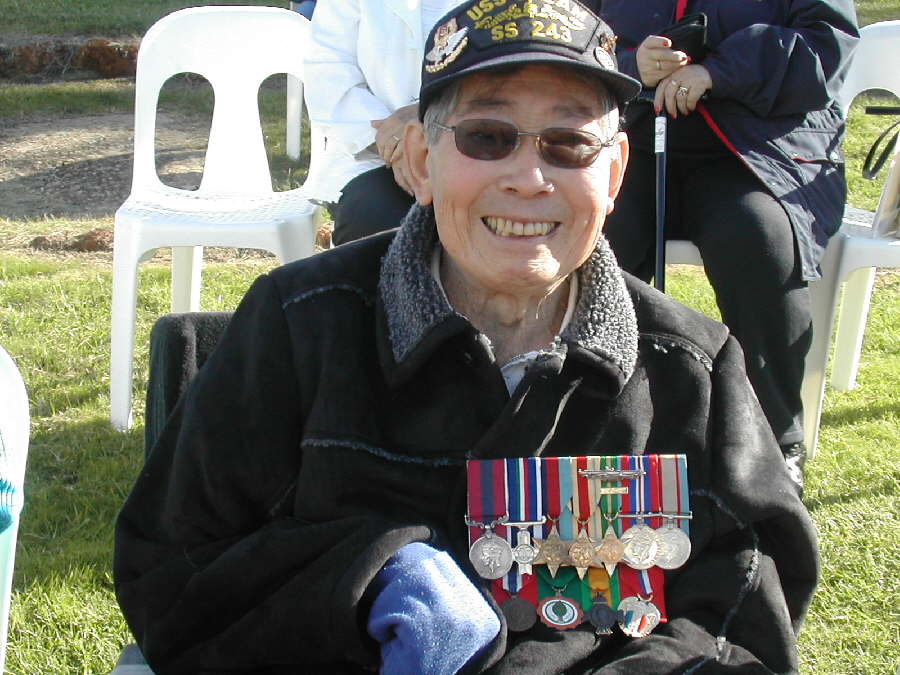
It is with great sadness that I make this post. Jack Wong Sue OAM DCM, WW2 ANZAC, has passed away at the age of 84.

It was over a year ago on ANZAC day when I first noticed Jack while channel surfing. He was in the ANZAC day march in Perth and my first reaction was "wtf". I was confused. The commentator said something along the lines of "...WW2 veteran Jack Wong Sue..." I made a mental note to chase this up. This is something I never expected to see.

ANZAC day for me has always been a day when the whites grandstand over the rest of us. That we were just 'japs' and we were a threat to them in WWII, conveniently forgetting that the other menace during WWII were the Germans, aka whites. Or that I wasn't even a 'jap'.

So to see someone with Asian features in the ANZAC parade was truly mystifying. In my full twelve years of Australian education, not one teacher had even hinted that there may be Australians of non-white race, apart from indigenous Australians, fighting for Australia. No one ever told me about Chinese Diggers. You can see why they would omit those details.

Anyway, it wasn't until this year that I started to do a bit more research and boy was I surprised. There seemed to be so many: John Joseph Shying, Billy Sing, Jack Wong Sue, Kate Quan and many more.  There are also many who had fully anglicised names who we may never track down, and many mixed children of Chinese fathers and white mothers who took on their mother's maiden name when enlisting in the hope that they would not be discriminated against by the army/government.

In addition to these, there were also many who were denied the opportunity to fight for their country due to discrimination and many whose efforts were not recognised. The Australian Government had betrayed them.

Jack himself suffered a lot of racial discrimination and abuse before, during and after the war. Yet despite all of this he was a determined man who achieved everything with steely resolve. He took crap from nobody, not even higher ranked officers. A larger than life character who was skilled in many things, he enjoyed scuba diving and playing music with his band. I don't think my descriptions or his wiki do him justice. I really recommend reading his book "Blood on Borneo".

I had been in discussions with his son Barry on Friday about making a documentary on Jack's life, especially before and after the war. Barry had told me his father was really sick and it had gotten worse. So this afternoon when I came across a story about his passing away, I was shocked but not surprised.

We've lost one of our greatest.

Lest we forget.


Hear Barry Sue talk about his father
World War II hero Jack Sue has died in Perth at the age of 84.

Mr Sue was a member of Z Special Unit, a special forces reconnaissance unit which operated behind enemy lines in South-East Asia during World War II.

Z Special Unit was the predecessor to the Special Air Service Regiment.

Mr Sue spent months behind enemy lines in Borneo and in his memoirs claimed Z Special Unit commandos in Borneo killed 1,700 Japanese and trained 6,000 guerrillas.

Allied forces later invaded Borneo.

Mr Sue was awarded the Distinguished Conduct Medal and rose to the rank of Sergeant during his army career.

He was awarded the Order of Australia in 2006.

His son Barry Sue confirmed he died today.

In 2006, The West Australians' Rod Moran wrote of Mr Sue's war-time exploits.

Head-hunting Dyaks, murderous Japanese infantry and the tragedy of the Sandakan Death Marches in the fetid jungle of what was then British North Borneo provided the grim backdrop to teenage warrior Jack Wong Sue's experience of World War II in the South-West Pacific, Moran wrote.

His award of the Order of Australia Medal was partly for his recording of those experiences in Blood on Borneo, a remarkable memoir of his nine months behind enemy lines in 1944-45. Published in 2001, more than 17,000 copies of the book have been sold in WA alone.

But Mr Sue's trajectory to war began when he was merely 16 years old. After receiving a white feather in the mail - a symbol of cowardice - he joined the merchant navy, sailing the submarine-infested high seas on a Norwegian oil tanker.

En route, he rubbed shoulders with nazi sailors on shore leave in pro-German neutral ports, and witnessed the fiery death by torpedo of an Allied merchantman at night.

On returning to Fremantle he attempted to enlist in the Royal Australian Navy, but was rejected because of his Chinese background. The fact that he was Australian-born and that China was a wartime ally made no difference.

Ironically, it was precisely his oriental appearance and connections - as well as his fluency in Chinese and Malay - that led to Mr Sue's recruitment into Z Special Unit, an ultra-secret organisation that infiltrated agents behind Japanese lines throughout the South-West Pacific for sabotage, guerilla warfare, and intelligence gathering.

After extensive training in the ruthless methods and technologies of clandestine warfare, Mr Sue was sent into the field as agent AKR 13. Leaving Fremantle on the USS Tuna, he was inserted into Borneo to conduct operation Agas 1. He had been issued with “L-tablets”, lethal capsules to be ingested if captured. At the time, Borneo was occupied by 37,000 troops of the Japanese Imperial Army.

The aim was to gather intelligence on Japanese troop movements as a prelude to the Australian invasion of Borneo. It was during this operation that Mr Sue won the Distinguished Conduct Medal for his actions in securing intelligence at Bongawan railway station.

Mr Sue was also involved in Operation Kingfisher, a plan to rescue the PoWs at the brutal Sandakan prison camp in northern Borneo. With nearly 2000 Japanese troops in the area, Mr Sue had to reconnoitre the camp and its hinterland.

All but six of the 2400 prisoners at the camp died on the subsequent Sandakan Death Marches, or were murdered at the camp itself. Mr Sue is the last living witness to the third and final march.

Historian Lynette Silver, author of Sandakan: A Conspiracy of Silence, describes his predicament: “Into their line of vision came a contingent of Japanese guards, followed by four skeletal creatures, so starved and emaciated they looked more like mummified corpses than human beings.” They were Australian PoWs.

Mr Sue's instincts told him to kill the guards and free the prisoners. But his training told him to stay under cover. The image of his countrymen as the living dead haunted Mr Sue.

In 1945, at the age of just 19, Mr Sue emerged from the jungle emaciated, psychologically haunted and a decorated war hero. With great fortitude, he began the process of building a new life in civvy street.


Jack Sue, a quiet hero and a brave man
World War II RAAF Officer and Z Special Unit hero Jack Sue remembered
PerthNow
ABC
Yahoo

Join the Asian ANZACs page.

Thursday, September 10, 2009

Happy Birthday Jack


Jack is a WW2 veteran who fought for Australia against the Japanese in British North Borneo.  Jack turns 84 on the 12th of September.  I'm currently reading his book Blood on Borneo and wow has this guy had an amazing life.  Happy Birthday.

A lot more on Jack's life can be found  at
www.jackwongsue.com
I am currently in discussion with his son Barry on some form of interview so stay tuned.

Jack is one of the hundreds (possibly thousands) of Australians of Asian heritage who fought for Australia at a time when the White Australia Policy was active and discrimination was prevalent.  Asian Australians have fought in every war (including the Boer War) and yet we are always seen as foreign or not up to the task  The Defence force didn't record details of race back then so a lot of us would only be able to find the veterans of asian descent by name, if their name hadn't been anglicised too much that is.  Many many eurasian kids of Asian fathers and white mothers also elected to use their mother's maiden name (to seem more European) to get past the discriminatory recruitment practises.

If you read up on Simpson's life (John Simpson Kirkpatrick - the guy with the donkey(s)), you'll realise Simpson wasn't born here and definitely didn't spend much of his life here, he only had lived in Australia for four years and had only joined the war for a free passage to England.  And yet we get taught in class how much of an Aussie hero Simpson was.  What the?  Why don't they tell the truth, oh yeah it'll probably shatter the "Anzac Legend" myth that they have worked so hard to cultivate.  Don't get me wrong, Simpson was some sort of a hero, but there are so many homegrown Aussies and 1.5 generation Aussies who fought in the wars we should be reading about in class and appreciating.  Simpson is definitely not one of them, not as an Aussie anyway.